About
From a courtyard in Ufa to Russia's Book of Records, the theatre and the sky
Nikolai Balashov was born in Ufa. In his own words, the circus studio he joined as a boy turned out to be "far more interesting" than hanging around the courtyard — so he stayed in the circus rather than on the street. Before the ring, he worked as a milling machine operator, a cinema projectionist and a trolleybus driver — "you should try everything in life, it always comes in useful" — and he says that experience has served him well as a performer too.
"You should try everything in life — it always comes in useful"
He began his touring career with the Tomsk Philharmonic — the early tours were gruelling: cold venues, several shows a day, constant travel, loading and unloading the equipment by hand.
A circus artiste since 1984. Over forty years he has performed on stages and at festivals in Poland, Finland, Germany, Turkey, Israel, Cyprus, England, the UAE, Qatar, Taiwan, Macao and Hong Kong. Today "Shou Balashova" performs across Russia, with international engagements available by arrangement.
The act began as an experiment: balancing on three plastic cups. "I kept inventing something new, dropping what didn't work, refining it," he says — and that's how the equilibrium-on-rolls act was born, the one that caught Moscow's attention and got him into Russia's Book of Records.
Nikolai set the rolls act aside — the genre puts too much strain on the back for years of practice. But he still juggles on the free-standing ladder to this day. He calls both genres extreme: "the state retires you after fifteen years in these genres, and you retire as an invalid."
"Not everyone is lucky, but I've been lucky — I haven't broken or dislocated anything yet"
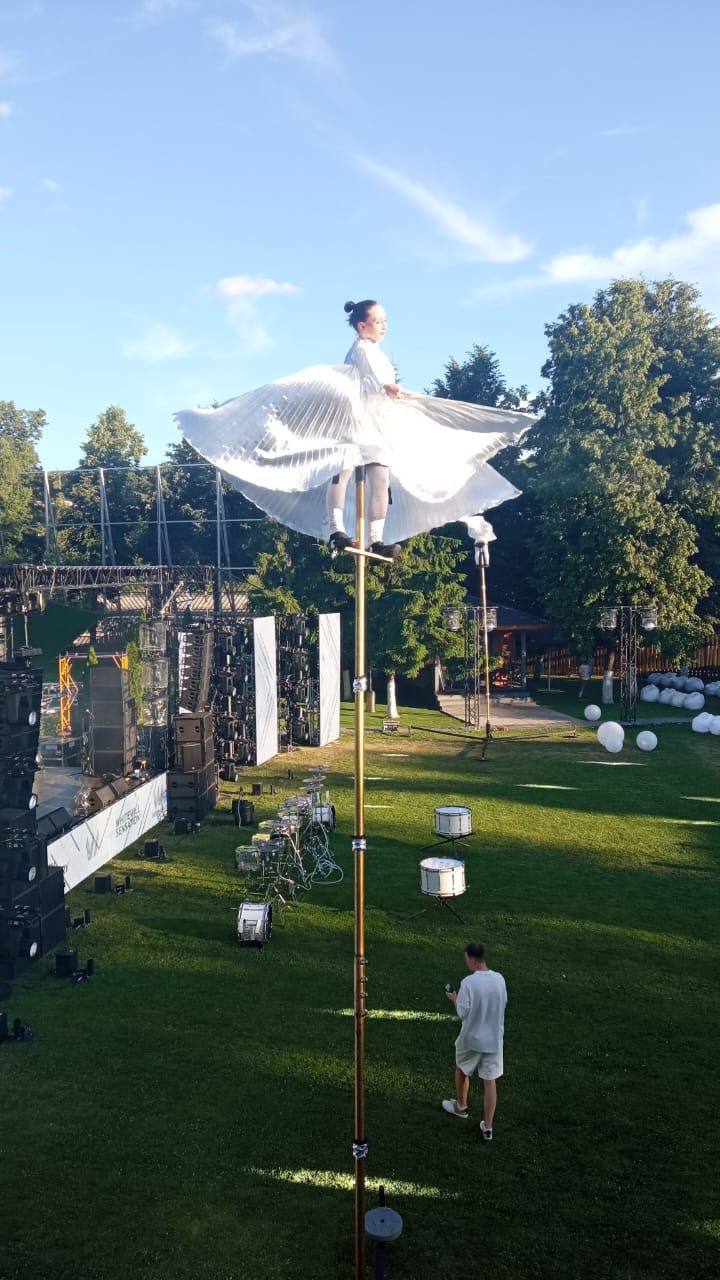
Flexible poles — a genre performed by only three or four theatres worldwide. The idea came from watching a Canadian or Australian circus troupe perform on Palace Square; he and a partner spent a full year building their own version, with plenty of trial and error. Today the act uses two 6-metre poles that flex up to 2.5 m to one side — a rare attraction for Russia that works year-round, indoors and outdoors. In the interactive part of the show, the artiste sways at the top and throws balloons to the crowd, while guests try to hit him with a soft ball; afterwards, willing volunteers can climb up and swing themselves.
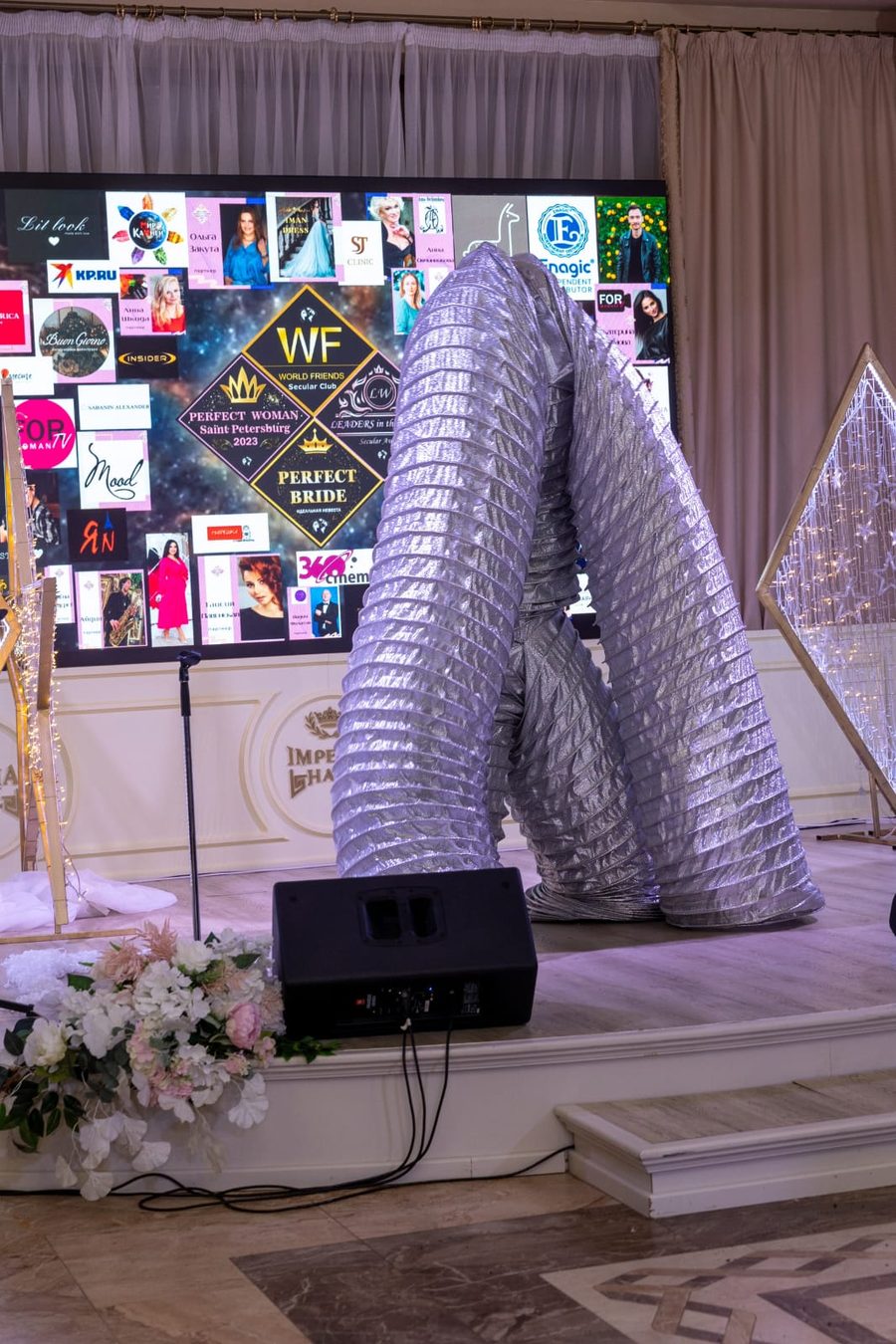
The Transforming Tube — he saw the act performed by an American artiste at a festival in Dubai and bought it. When the prop wore out, he sewed a new one himself — "heavy manual work", made in 6 different colours. The solo number "Cosmic Fantasy" runs eight minutes and uses three tubes; there's also a paired version, "the trained tube", where a dompteuse in white and a black tube act out a scene of confrontation.
At fifty, Nikolai learned to fly a powered paraglider. Since his whole life has been tied to the circus and to height, he combined the two: he found pilot Yuri Dybov, a light-aviation champion, and pitched him a joint project. He brought in four professional trapeze gymnasts and built a narrow circus ladder on the side of the rig for easy climbing — then tested it all in an open field.
The result was a full aerial show — rare even by world standards (a similar act exists in Novosibirsk on a paraglider, but that's different: a paraglider depends on air currents, while a powered paraglider can stay airborne as long as needed). The project turned out expensive, and then the economic crisis and Covid arrived — it never scaled up to the big city festivals he'd hoped for. Footage of the show survives on video.
He was invited to the Mikhailovsky Theatre for the opera "La Bohème" — first as a stilt juggler in the "Fair" scene, then for three years as a stunt performer. After that came the acrobatic stunts for the Mariinsky Theatre's "A Midsummer Night's Dream".
Later he was invited to the Musical Comedy Theatre, which was staging "Princess of the Circus". Nikolai brought together professional circus artistes across several genres and became director of the acts and head of the circus troupe. The difference from the ring is real: the theatre calls for short fragments rather than full solo turns, and the troupe performs only twice a month.
Nikolai joined the academy after meeting its secretary on a film set. He teaches film and theatre actors basic circus skills — juggling, acrobatics: "an actor's training should be well-rounded, they should be able to juggle something — it comes in very useful on set."
"We only get one life, and living it as if it doesn't matter — wasting it — that's a nightmare."